An ewq (echocardiogram) is a crucial, non-invasive ultrasound test used to detect and monitor cardiac amyloidosis—a condition where abnormal proteins called amyloids build up in the heart muscle, making it stiff and impairing its function.
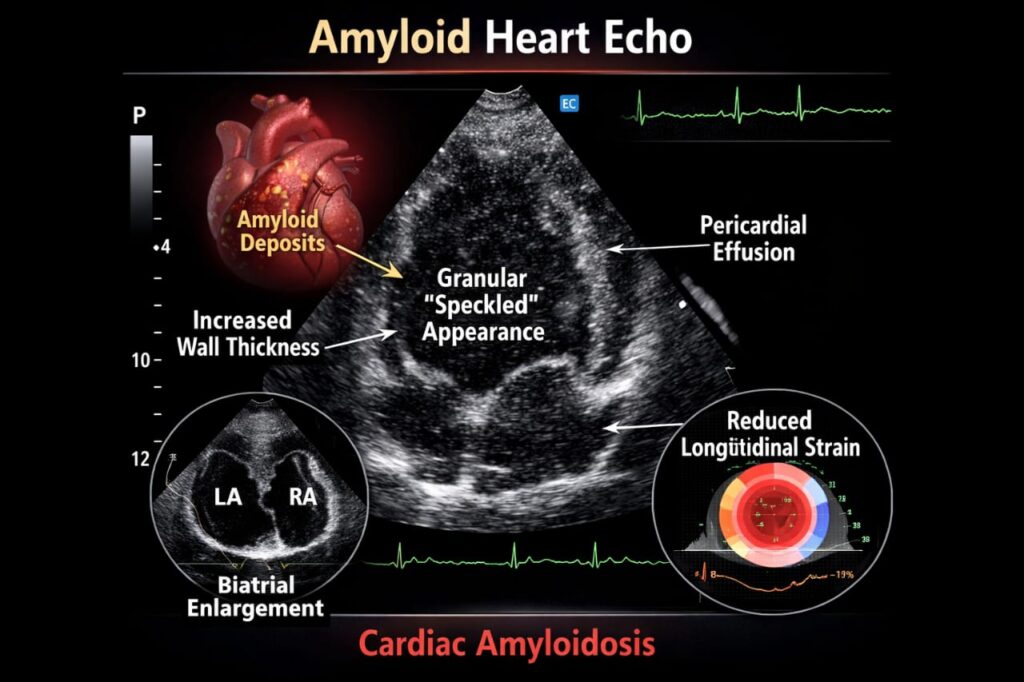
Key echocardiographic findings suggestive of cardiac amyloidosis include:
1. Increased Wall Thickness:
- Finding: The walls of the left ventricle (LV) and often the right ventricle appear concentrically thickened (hypertrophic).
- Amyloid Heart Echo Clue: This thickening is not due to high blood pressure and is often disproportionate to the patient’s history. It can mimic hypertrophic cardiomyopathy.
2. Granular or “Sparkling” Myocardial Texture:
- Finding: A classic, though not always present, finding where the heart muscle has a granular, sparkly appearance on the ultrasound image.
- Amyloid Heart Echo Clue: This results from the acoustic mismatch caused by amyloid protein deposits infiltrating the tissue. It is a strong visual indicator for the sonographer.
3. Diastolic Dysfunction (Restrictive Pattern):
- Finding: Severe impairment in the heart’s ability to relax and fill with blood. This is often an early sign.
- Amyloid Heart Echo Clue: Assessed via Doppler measurements of mitral valve inflow (E/A ratio) and tissue Doppler imaging (e’ velocity). A pattern of “restrictive filling” (high E/A ratio, very low e’) is common in advanced disease.
4. Preserved or Reduced Ejection Fraction:
- Finding: The squeeze (ejection fraction or EF) may be normal in early stages but often declines as the disease progresses.
- Amyloid Heart Echo Clue: Preserved EF with thick walls and diastolic dysfunction is a classic red flag combination that should prompt consideration of amyloidosis.
- Finding: Both the left and right atria are significantly enlarged.
- Amyloid Heart Echo Clue: This results from the high pressures in the stiff ventricles during filling, causing backup into the atria.
6. Thickened Heart Valves and Interatrial Septum:
- Finding: Amyloid infiltration can also affect valves and the wall between the atria.
- Amyloid Heart Echo Clue: Valves may appear thickened but are usually not severely dysfunctional. Septal thickening is another supportive sign.
7. Pericardial Effusion:
- Finding: A small to moderate amount of fluid around the heart is common.
- Amyloid Heart Echo Clue: Its presence in conjunction with other findings adds to the suspicion.
8. Advanced Strain Imaging Findings:
- Finding: Global Longitudinal Strain (GLS) is reduced, often showing a characteristic “apical-sparing” pattern.
- Amyloid Heart Echo Clue: This is a highly sensitive and specific modern echo technique. While the base of the heart shows poor contraction (strain), the apex remains relatively preserved—a hallmark pattern for cardiac amyloidosis.
The Role of the Amyloid Heart Echo:
- Screening: For patients with red flags (e.g., heart failure with preserved EF and thick walls, carpal tunnel syndrome, neuropathy).
- Diagnostic Clue: Provides the initial major clues that trigger further testing (e.g., blood/urine tests, nuclear scintigraphy [PYP scan], or cardiac MRI).
- Monitoring: Tracks disease progression and response to therapy.
Conclusion:
An amyloid heart echo is the foundational imaging tool for evaluating suspected cardiac amyloidosis. Its findings—particularly the combination of thickened walls, diastolic dysfunction, a sparkling appearance, bi-atrial enlargement, and the apical-sparing strain pattern—create a distinctive footprint that guides clinicians toward a definitive diagnosis and management plan for this serious condition.
A Clear Guide to Echocardiogram in amyloid heart echo
An echocardiogram, commonly called a heart echo, is the primary imaging tool used to initially detect and assess cardiac amyloidosis, a condition where abnormal proteins stiffen the heart muscle. This guide explains how an amyloid heart echo works, what specialists look for, and its critical role in diagnosis.
What is an Amyloid Heart Echo?
An amyloid heart echo is a standard transthoracic echocardiogram specifically interpreted for signs of amyloid infiltration. It uses ultrasound waves to create real-time images of the heart’s structure, movement, and blood flow. Unlike an amyloid heart scan (which uses nuclear tracers), the heart echo is non-invasive, radiation-free, and widely available, making it the ideal first test when amyloidosis is suspected.
Key Findings on Echo for Amyloid Detection
The echo diagnosis of cardiac amyloidosis relies on a combination of characteristic features:
- Increased Wall Thickness with Granular Sparkling
- The heart muscle appears abnormally thick and may have a bright, speckled, or “ground-glass” texture. This results from amyloid protein deposits within the tissue and is a classic visual clue for an amyloid heart.
- Diastolic Dysfunction (Impaired Relaxation)
- The heart becomes stiff and cannot relax properly to fill with blood. Doppler measurements show a restrictive filling pattern, an early and sensitive sign in the echo diagnosis pathway.
- Preserved Ejection Fraction (Early Stage)
- Initially, the heart’s pumping strength (ejection fraction) may appear normal despite significant wall thickening and stiffness. This disconnect is a major red flag prompting further amyloid detection efforts.
- Bi-Atrial Enlargement
- Both upper chambers (atria) are often significantly enlarged due to the high pressure caused by the stiff lower chambers, a common finding in advanced amyloid heart disease.
- Pericardial Effusion
- A small-to-moderate amount of fluid around the heart is frequently seen.
The Advanced Tool: Global Longitudinal Strain (GLS)
Modern heart echo software includes speckle-tracking echocardiography to measure GLS—a sensitive assessment of the heart’s squeezing function. The hallmark pattern for amyloidosis is “apical sparing,” where the bottom (apex) of the heart contracts relatively normally while the base is severely impaired. This pattern is highly specific for amyloid detection and helps differentiate it from other causes of heart thickening.
Role in the Diagnostic Pathway
The amyloid heart echo functions as a crucial gatekeeper in the diagnostic process:
- Step 1: Suspicion: A heart echo is performed for symptoms like heart failure, shortness of breath, or fatigue. The combination of thick walls, diastolic dysfunction, and (if available) apical-sparing strain raises immediate suspicion for an amyloid heart.
- Step 2: Trigger for Confirmation: These echo diagnosis findings are not definitive but are strong enough to warrant specific confirmatory tests. This typically leads to the next critical step: an amyloid heart scan (PYP/DPD/HMDP nuclear scintigraphy) and blood/urine tests for clonal proteins.
- Step 3: Monitoring: After diagnosis, serial heart echo exams are used to track disease progression, monitor therapy effectiveness, and assess heart function over time.
Limitations and Next Steps
While the amyloid heart echo is excellent for raising suspicion and assessing cardiac function, it cannot identify the type of amyloid protein (e.g., AL vs. ATTR). This is where the amyloid heart scan and hematologic workup become essential. The echo diagnosis therefore creates the essential link from initial clinical suspicion to targeted, definitive testing.
Summary Table: Echo vs. Scan in Amyloidosis
| Feature | Amyloid Heart Echo (Echocardiogram) | Amyloid Heart Scan (Nuclear Scintigraphy) |
|---|---|---|
| Purpose | Assess heart structure/function, raise suspicion | Identify amyloid type (especially ATTR), confirm diagnosis |
| Technology | Ultrasound | Nuclear tracer (e.g., Technetium-99m) |
| Key Findings | Thick walls, diastolic dysfunction, apical sparing | Heart uptake of tracer (grade 2-3) with absence of light chains |
| Role | Echo diagnosis trigger, monitoring | Definitive amyloid detection for ATTR type |
Conclusion: An amyloid heart echo is the indispensable first-line imaging test for cardiac amyloidosis. By recognizing its characteristic findings—thickened walls, diastolic dysfunction, and apical-sparing strain—clinicians can make a timely echo diagnosis. This critical step then guides the rational use of confirmatory tools like the amyloid heart scan to achieve precise amyloid detection and initiate appropriate treatment.